
In my business, planners are an essential external tool to support the brain. A planner is your time, task, and life organizational system.
But every time I mention this word to people of all ages, their face changes.
For some, the expression becomes righteous: “I have been telling them to use a planner and they don’t! I was right!”
Others roll their eyes. “Here we go again. Planners don’t work for me. I just know I won’t use it.”
Others enjoy picking out the perfect planner, use it for a time, and then go pick out a new one, forever in search of the one planner that will solve all their problems.
And the last response I get? “I have a planner!” And then they pull out their phone.
Parents are baffled. Schools introduce a planner, spend funds on the one they think will work, and then almost immediately give up on requiring students to write in it. Adults have tried so many times and failed that the thought of trying yet again feels so defeating.
It’s important to note that this resistance is very human and by no means a character flaw. It’s because of the brain! Let me explain.
Why have so many people become resistant when it comes to planners?
Reason #1: The way you use a tool dictates its usefulness.
When you use a tool, the brain connects its purpose to the activity you do with it most often. For example, if I ask, “What is a hammer for?” the most common answer is pounding in a nail.
But a hammer can also pull a nail out, smooth a bump, or make a hole. The claw end is an excellent digging tool. All of these are possible, but the brain’s first assumption is that it should be used to pound a nail.
The same thing happens with planners. If someone has only ever used a planner to jot down the occasional big deadline, the brain files it away as a “deadline recorder” rather than a time management system. So when someone hands you a planner and says “use this every day,” the brain pushes back because that is simply not what it has learned this tool is for.
Reason #2: If the tool is not useful, the brain rejects the object instead of the way it was used.
If I keep using the claw end of the hammer to pound in nails, I won’t be consistently successful. The brain labels the tool inefficient and either looks for something else or decides the task no longer matters.
This is why so many people conclude “planners just don’t work for me.” They have tried using a planner in a way that did not match how their brain really works, and their brain drew a very logical conclusion: this tool is not helpful. Common examples of this include:
- Only writing down big deadlines and never checking back in
- Using it consistently for a week and then abandoning it when life gets busy
- Filling it out so perfectly at first that any imperfection feels like failure
The problem is the approach, not the planner itself.
Reason #3: Metacognition matters.
If I’m using a hammer incorrectly, I might not automatically look for solutions. That requires pausing to think about what I’m doing and why.
Metacognition is the ability to think about your own thinking. It is the skill that allows you to step back, observe a pattern, and make an intentional adjustment. Without it, you will just keep doing what you have always done and wondering why the results are the same.
Our approach at EFS is to understand the brain first, then use metacognition to accomplish your goal. In other words, before we hand someone a planner, we help them understand why their brain works the way it does. That awareness is what makes the difference.
Use These Tips to Reverse Your Planner Resistance
The brain does not see the future clearly. Small squares with dots on a phone screen are a representation of the tasks and appointments you have scheduled, but don’t provide the full picture of your time. You need a picture of at least a full month to truly see your time.
Try this: open your phone calendar, then look at a printed monthly calendar. What do you see? Most people notice right away that the printed calendar gives them a much fuller sense of how much time they actually have, how busy their weeks are, and where the breathing room is. In other words, the phone shows you what is scheduled. The printed calendar shows you a bigger picture.
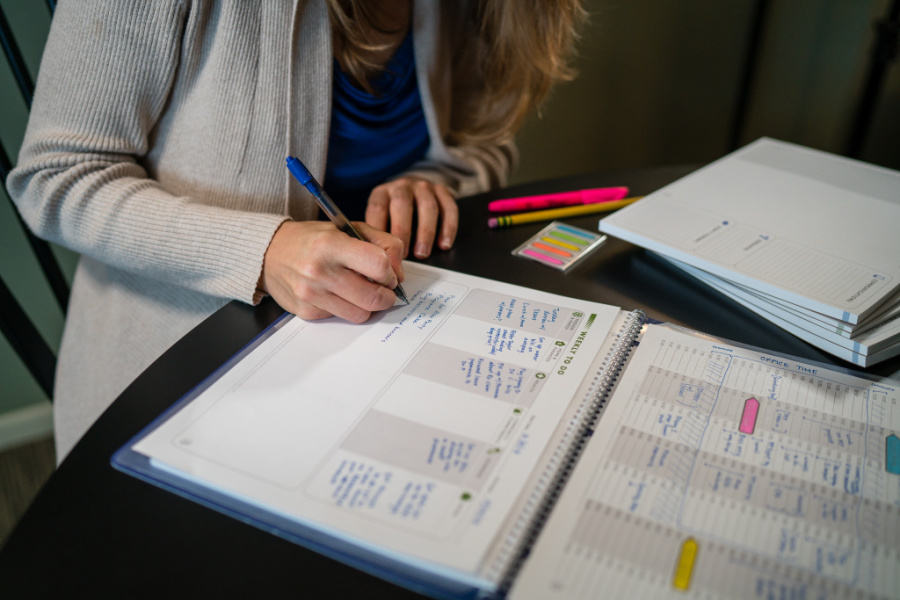
For the brain to focus, you need to know what to do next without a lot of decisions involved. One of the most valuable things a planner does is protect your brain’s energy. When you sit down to work and have to decide in the moment what to do first, that decision-making process drains mental energy before you have even started the task. We call this decision fatigue.
A planner solves this problem by doing the decision-making in advance. When you write down what you are going to do and when you are going to do it ahead of time, you free up your brain to focus entirely on the work itself.
The brain does what it sees. Having your tasks, appointments, and the time they take all visible in one place makes it dramatically easier to follow through. How would it feel to see your tasks, appointments, and the time they take, all visible, in one place? A planner is one option. Cool tools like dry-erase boards, sticky notes, and paper can all be very effective, depending on your needs.
Start with fun, not obligation. When you begin to associate your planner with things you look forward to, the brain starts to see it as a useful and even enjoyable tool. We call this planning for fun! Pay attention to the moments when your planning system works, and celebrate them. The brain remembers what feels good. Each small win reinforces the habit; success builds consistency.
Once you recognize that visualizing the week, month and year is useful for getting things done, the things you have to do become progress toward your goals!
When you are ready to explore what that could look like for you, we would love to help. The Seeing My Time® curriculum is built around this exact methodology, and all of our planners are designed from the perspective of the brain.
Shop Planners | Learn About Private Sessions | View All Courses
Happy Planning,