
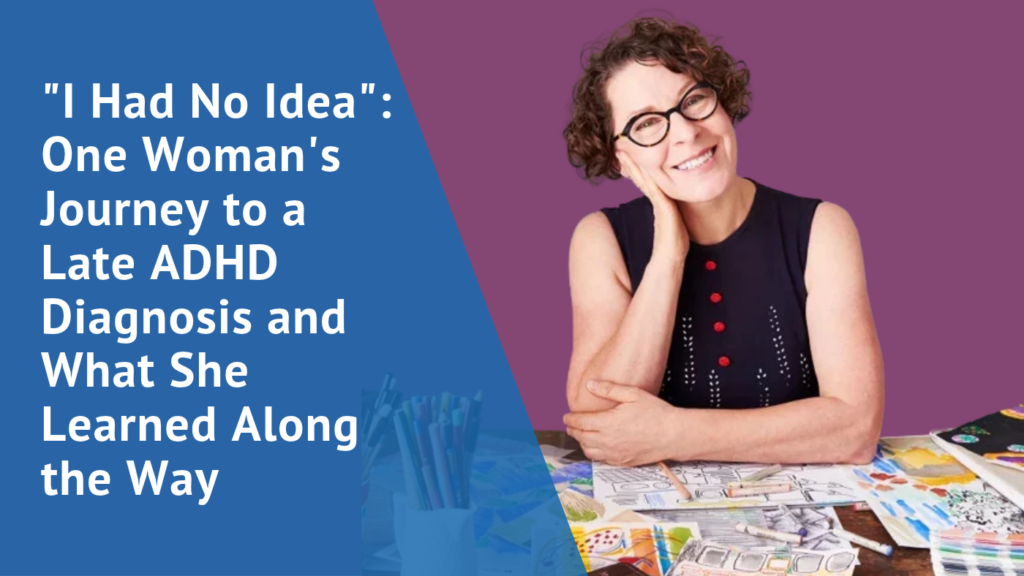
This month, we sat down with Snowden Flood, London-based artist, psychotherapist, and specialist in neurodivergent people, for a conversation about being diagnosed with ADHD during menopause, the long road to self-understanding, and the tools and strategies that have helped her thrive. What follows is an edited version of our conversation.
Snowden, can you start by telling us a little about yourself and your background?
My story is one of battling systems from quite early on. I grew up in England with American parents, attended a British boarding school, and was expelled from a couple of schools for poor performance. I was told by virtually everyone, ‘You’re bright, but you could do better if you tried harder.’ Whenever the school report would come, my mother would say, ‘I thought you said you’d try harder.’ And I’d always think, I thought I had! I really didn’t understand what was wrong.
At the time, nobody ever said anything specific or knew about ADHD, and nobody was supporting me. So I just struggled tremendously.
I eventually found my footing when I left home early and landed a job at an art school and basically found my people. Later, I went on to build a successful textile design business, working with clients like the Tate Modern, the British Museum, and Liberty London. I went on to have a son and find a lovely partner, and in my 50s, I retrained as a psychotherapist.
Today, I am an artist and a licensed therapist, specializing in working with neurodivergent women experiencing burnout, high functioning anxiety, and depression.

When did you first start to suspect you might have ADHD?
I eventually went to a therapist because I just felt awful. I was really, really struggling at that point, and had to close my gallery. I just couldn’t function at all. And after a while she said to me, ‘Have you ever considered that you might be neurodivergent?’
I had never thought of that. Ever.
But I said, ‘Well, I do have this issue with executive functioning.’ Like, for my gallery, I’ve got stock in a storage space, I’ve got to have enough for my web orders, to service my shop, and for all my wholesale customers, and I find it REALLY difficult to keep all straight. My friend Sophie would say, ‘Snow, what the hell’s wrong with you? This is so easy!’ And I’d be like, it’s NOT easy! That’s when I really noticed that there was something going on.
So my therapist said, ‘Go home and watch some YouTube videos about women with ADHD.’ I watched one, and oh my god, the tears were running down my face. I was just like, oh wow. I’ve got ADHD.
What was that moment of diagnosis like emotionally?
It was really devastating actually. It connected to a sort of shame part of me, like, I couldn’t do stuff. I think that really runs through most people who are late diagnosed. There’s just this foundation of, ‘I’m not functioning.’
The day of diagnosis, my son came home from school, saw my face and he said, ‘what’s wrong with you, mum?’ And I said, ‘Oh, I’ve got ADHD.’ And he said, ‘Of course you do! It’s so obvious!’
It took a while for any relief to come. There wasn’t a lot in the media about late diagnosis of women at that time, so I wasn’t being validated externally. I was still in that place of shame.
But I did a lot of research. I read Edward Hallowell’s books. I listened to Tracy Otsuka’s podcast, ADHD for Smart Ass Women, and it was really helpful, because she’d invite women on to talk about things like rumination, or rejection sensitive dysphoria, which I had always been really ashamed of. And it normalized it. “Oh, there’s a name for this. And there’s a way of dealing with it. I’m not just completely insane.”
You mentioned menopause playing a role in your diagnosis. Can you explain that connection?
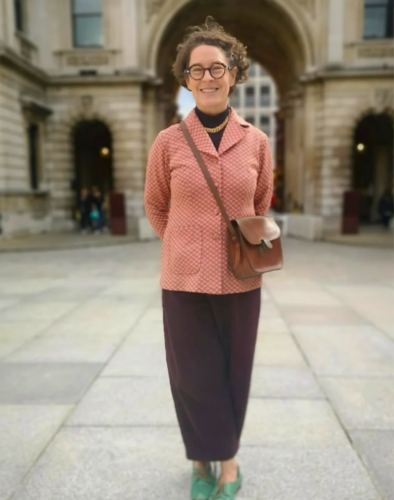 My therapist mentioned menopause specifically when she raised the possibility that I might be neurodivergent.
And I think what happens is that you’ve been masking and coping and functioning for years, and then menopause hits and the plummeting estrogen disrupts the brain’s dopamine pathways. All of that coping just goes in the bin. The things that had worked, or sort of worked, suddenly stop working. And you don’t know why.
For women who have been managing undiagnosed ADHD their whole lives, menopause can feel like falling off a cliff. And so often, nobody connects the dots.
What about the shame piece? So many women carry that for decades.
I think for a lot of us, there’s this long background of feeling like you’re not functioning. And when you’re dealing with planners or tools or strategies for ADHD, that shame is always there in the background. Like, why can’t I just DO this? Everyone else can do this.
What I’ve learned, and what I try to bring into my work with clients, is that the shame isn’t the truth. The systemic framework told you that you were useless. You were not useless. The system was not designed for your brain.
And the labels, as complicated as they can feel, can actually be really liberating. I still get to determine what I do with my diagnosis. It’s an empowered choice, not a life sentence.
That’s such a fabulous reframe. How did that shift eventually lead you to the work you do now as a therapist?
When I was at my lowest point, after closing my gallery, I knew I had to stop. I had burnout, though I didn’t even know that was a thing at the time. I just knew I was exhausted and something had to change.
As I went through my own diagnosis and my own process of understanding my brain, I started to see it reflected everywhere in my clients. So many of the women I work with are carrying decades of shame about the same kinds of struggles. They have been told their whole lives that they just need to try harder, and they believed it. My own story gives me a very particular kind of understanding of what that feels like, and I think that makes all the difference in my work.
My son is also autistic, and when he was diagnosed, I went through a
twelve-week course for parents of neurodivergent children. I learned so much. All of that knowledge, layered with my own late diagnosis and my therapy training, really shaped the kind of therapist I became. I specialize in neurodivergent women now because I know this territory from the inside.
Let’s talk about tools and strategies. What actually works for you day to day?
Honestly, I’ve had to really pare things down. I suffer from long COVID on top of everything, and my working memory is a struggle. So my expectations for myself are much lower than they used to be. For me, the 3-Task Rule works best. I choose three things I will accomplish each day and stick to them. No more.
I also have a paper diary, and I have alarms. Lots of alarms. I have post-it notes beside my bed, because I don’t always have a great sense of what day it is or where I am in the week, especially now. As a therapist, I can never miss a session. So I am very, very careful about this.
I also love body doubling. I use Focusmate, which is an online service where you meet virtually with someone else using the App. You each say what you’re working on, then you put the sound off and just work alongside each other for fifty minutes. It holds me there. Without it, I find myself in the kitchen cooking a meal an hour later, getting away from the things I have to do.
And timers. I don’t sit for very long, so I work in twenty to twenty-five minute chunks. That’s what works for my body and my brain right now.
What about the reward piece? You mentioned that the ‘Eat the Frog’ method doesn’t work for the ADHD brain.
I hate Eat The Frog. A good friend of mine with ADHD works from home, but I remember she once told me that she walks to work. When I expressed confusion, she shared that she goes out, gets herself a coffee, walks back, and arrives at the door at the same time as whoever was coming to work with her. And they’d all be on the doorstep together, and that was the start of the working day.
It’s genius, because it’s reward-based. Why would we want to eat a frog? Give me something I actually want. A coffee. A walk. A sense of arrival. That’s what gets the ADHD brain moving.
That it takes time. There are lots of steps. And self-compassion is not optional. Self-compassion IS the work.
I remember once during meditation noticing that I was panicking about not having planted my kale seeds yet. And when I noticed that thought, it gave me this overview of where my mind actually was. I literally can buy kale from the market. I was punishing myself over kale. And I could see all these areas where I had tried to exercise control just to feel like I could do it all. Those thoughts were not serving me. In fact, they were making me sick.
So for me, the question now is always: what can I pare down? What are my three things? What does my nervous system actually need today?
That’s a really long journey to get to. But it is possible. And it is worth it.
About Snowden Flood
Snowden Flood is a London-based artist and psychotherapist specializing in neurodivergent people experiencing burnout, high functioning anxiety, and depression. You can learn more about her work at snowdenflood.com.
At Executive Functioning Success, we work with individuals of all ages to understand their unique executive function profile and find the external tools and strategies that fit their brain. If this conversation resonated with you, we would love to talk. Schedule a free discovery call with Julie here.
